

By T’Erica James
With the 2026 campaign season coming to an end, questions about where HBCU students reside in the minds of elected officials still stand. While the push to encourage young voters dwindles after Election Day, the issues students face still remain long after the campaigning is done and the winners are announced.
HBCU students know all too well the struggles faced dealing with school, life, work, and the never ending unpredictability of all three. Kaina Majuste, a second year political science major from Fort Lauderdale, Florida talks about the importance of actually making these investments and not just promises.
“I was drawn to FAMU because of the culture, yes, but equally because I understood the importance of going to a school where you aren’t an afterthought. HBCUs have long been held as gateway institutions to higher education, but politicians often disregard or fail to account for that when divvying up funding for state universities.”
Majuste said though she believes FAMU is dedicated to producing the next generation of black professionals, corners are often cut when sufficient financial resources aren’t available.
“The inefficiency of FAMU’s bureaucracy frequently crosses into incompetence and is something of a running joke among students. Everyone has a story of a time when they went to the financial aid office for information or guidance only to receive neither.”
“Or one about their advisor failing to give them appropriate, well-informed guidance, resulting in a delayed graduation or redundant credit. Or the paycheck from their on-campus jobs being delayed.”
According to Majuste, stories similar to these occur in almost every administrative department on campus. She says this is not just a FAMU issue; it's an issue that nearly every HBCU has encountered, and coined a rite of passage.
“Being at FAMU has removed so many of the educational barriers that I have faced at other levels of education because Black students are an afterthought within the education system. However, FAMU and HBCUs in general cannot truthfully claim to value Black students until they stop sacrificing the quality of crucial education infrastructures."
The election season is a critical time and shouldn’t be taken lightly, but many students feel as though this is the only time their voices are being heard. Iryiana Lloyd, a second year philosophy major from Baltimore, Maryland, says she believes politicians only care about HBCU student opinions during election season, when student voices are more of a priority.
“They feel like if they do prioritize, hypothetically, more youth or collegiate engagement, that people are not gonna show up and actually give their opinions. The second problem is I think considering what the political climate is in certain states, some of the leadership don’t correlate with youth values, so they rather not put anything that they consider ‘propaganda’ into the minds of other adults.”
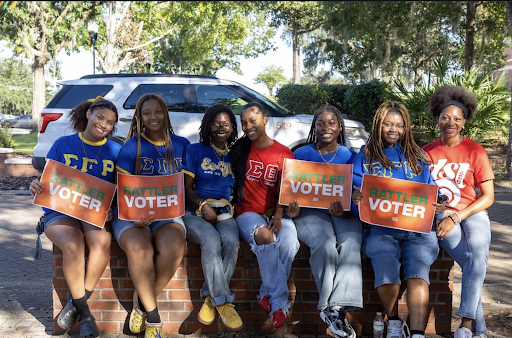
Students from various Greek organizations on FAMU campus posing while holding “Rattler Voter” signs for Stroll to the Polls, posted on FAMU’s Instagram page.
Lloyd believes that if politicians spent more time trying to understand perspectives outside of their own, they’d better be able to cater to them.When asked what issue she’d ask elected officials to address if given the opportunity, Lloyd was in search of accountability.
“Well, I understand equality for all was intended for everyone to be equal, but if the system is unbalanced in itself, giving everyone equal treatment still favors one over the other and needs to be worked on as a problem within the collegiate space,” said Lloyd.
Lloyd says she believes politicians make promises based on what they think HBCU students need and not what is actually needed.
“I feel like a lot of politicians do not promise specific things, but promise the world, but they can’t understand the world is different for everyone else so their perfect ideology does not match the actual voter profile,” Lloyd said.
HBCUs are the foundation of varying ideologies and beliefs as students have historically expressed public outrage and concern over what they’re seeing. FAMU Students for a Democratic Society (SDS) Vice President Jayla Jones, a third year political science major from Saint Louis, Missouri and her organization are among the students that have dedicated their platform and organization to raising awareness and advocacy.
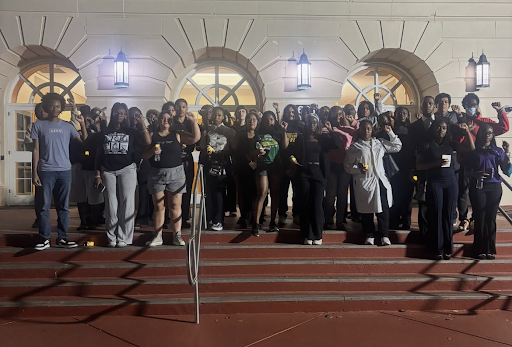
Members of FAMU SDS and other organizations gathered for a protest in front of Lee Hall Auditorium on FAMU’s campus on September 18th to honor the life of Pierre Damas Bel and fight against the 287 (G) Agreement with ICE.
According to their instagram bio, FAMU SDS is a student organization that focuses on fighting injustices at FAMU and around Tallahassee, Florida.
Jones believes the key to getting politicians to address issues affecting HBCU students is to know who is passing/trying to pass the bill and how it will affect HBCU students, then engage in local politics and engage in those city council and commissioners meetings.
“FAMU SDS gives a voice to students whose voices have not been heard by FAMU admin and the government who has its hands in our school’s policies. We bridge gaps between other student organizations and Tallahassee political organizations to make sure our message is heard by taking our demands to the capitol and on campus grounds,”Jones said.
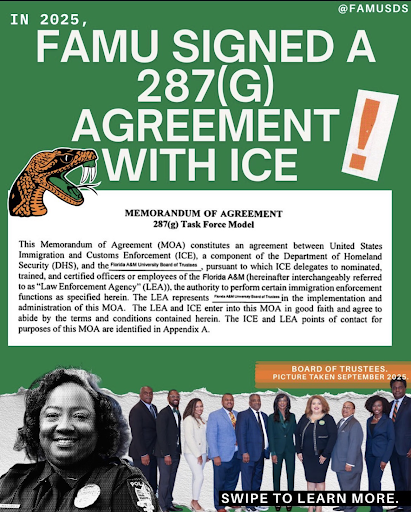
A graphic posted on FAMU SDS’s Instagram page highlighting the 287 (G) agreement and all those involved with its implementation.
According to Jones, students are scared to speak out in lieu of Florida’s attacks on first amendment rights and the FAMU SDS encourages students to speak up if they want to be heard despite the laws. Jones believes the biggest issues facing FAMU that officials are overlooking is the consolidation of their majors, ICE being on campus, housing issues, and finances not being allocated more towards students.
“What we are seeing is the ladder being pulled up for easy, entry level positions requiring higher expectations of students, or an unlivable wage,” said Jones.
When talking to Jones, she stated that trust and understanding are crucial to HBCUs and Black voters as the majority of those demographics vote to protect themselves and the future of their communities. For many HBCU students, being heard during election season is simply not enough; what matters is officials continuing to listen long after all the votes have been counted.
